

Rummy is a competitive card game that challenges players to organize their cards, observe opponents, and make calculated decisions when drawing or discarding. At TTTPH, the JILI version uses 13 cards, requiring participants to form valid combinations before declaring. Beyond the initial deal, the game emphasizes card management and strategic Joker placement. This guide explains Indian Rummy rules, scoring methods, and the decisions that influence each round.
Overview of JILI Rummy and Its 13-Card Gameplay
Rummy was released by JILI Games in July 2021 as a Table and Card title inspired by traditional Indian Rummy. The game features multiplayer competition, where participants arrange 13 cards into valid Sequences and Sets. Its defining feature at TTTPH is the combination of mandatory card arrangements, Joker-assisted combinations, and the Declare mechanism used to determine the winner.

| Information | Details |
| Game title | Rummy |
| Provider | JILI Games |
| Release date | July 2021 |
| Category | Table and Card |
| Theme | Multiplayer Indian Rummy |
| Cards per player | 13 |
| Main objective | Form valid combinations and Declare |
| Main combinations | Pure Sequence, Impure Sequence, Set |
| Special cards | Joker, Printed Joker |
| Main actions | Draw, Discard, Declare |
| Action time limits | 20 seconds to draw and 20 seconds to discard |
| Published Max Win | 320x |
| Paylines | 0 |
Requirements for Building a Valid Winning Hand
In Rummy, players do not win by holding the highest-value cards. Instead, all 13 cards must be organized into valid combinations. A winning hand requires at least two Sequences, including one mandatory Pure Sequence. The remaining cards may form additional Sequences or Sets of matching ranks. Missing any required combination can make a Declare invalid, even when the hand contains several seemingly strong groups.
Once the arrangements are complete, players select the card to discard and use Declare instead of the normal Discard action. The system checks whether the hand satisfies the winning conditions. The first player to Declare correctly wins, while opponents receive penalty points for cards that have not been properly arranged. At TTTPH, understanding these requirements helps prevent premature declarations and avoidable scoring penalties.
Three Card Combinations That Determine a Valid Declare
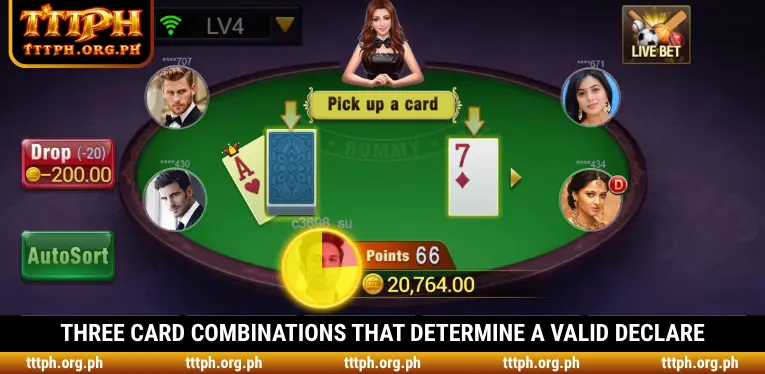
Learning how Sequences and Sets differ is essential for building a complete hand efficiently. These combinations form the foundation of Rummy and determine how newly drawn cards should be used during each turn.
Pure Sequence Requires Consecutive Cards Without Joker Substitution
A Pure Sequence consists of at least three consecutive cards of the same suit, such as 4♥, 5♥, and 6♥. Players must use naturally matching cards rather than substituting a missing rank with a Joker. A card designated as a wild Joker may still be used at its natural rank and suit when it belongs to the sequence.
Impure Sequence Uses Jokers to Complete Missing Cards
An Impure Sequence also consists of at least three consecutive cards of the same suit, but Jokers can replace missing cards. For example, 7♠, Joker, and 9♠ form a valid sequence when the Joker represents 8♠. This combination can reduce the number of turns required to complete a group, although it cannot replace the mandatory Pure Sequence.
Set Combines Matching Ranks From Different Suits
A Set contains three or four cards of the same rank but different suits, such as 8♠, 8♥, and 8♦. Jokers may substitute for missing cards when permitted by the rules. However, a hand consisting of several Sets cannot be declared unless the player has also completed two required Sequences, including one Pure Sequence.
How to Play Rummy at TTTPH
To begin Rummy, players select a suitable table, receive 13 cards, and take turns drawing and discarding in clockwise order. At TTTPH, the gameplay revolves around observing the two card piles, arranging combinations, and declaring once every winning condition has been satisfied.
- Step 1 – Open the JILI game: Log in to TTTPH, enter the card games category, select Rummy, and review the table’s betting requirements before joining.
- Step 2 – Examine your 13 cards: Sort the cards by suit and rank to identify potential Sequences, Sets, and the cards that could form a Pure Sequence.
- Step 3 – Draw one card: Take a card from the face-down draw pile or the top of the face-up discard pile if it helps complete a useful combination.
- Step 4 – Discard an unnecessary card: Rearrange your combinations after drawing, then discard a card with limited strategic value to return your hand to 13 cards.
- Step 5 – Complete your hand and Declare: Verify the Pure Sequence, second Sequence, and remaining valid groups before using Declare to submit the completed hand.
How Jokers Change the Way Card Combinations Are Built
In Rummy, Jokers act as substitute cards that help complete Impure Sequences and Sets. The JILI version includes both Jokers and Printed Jokers, which function as substitutes according to the game’s rules. Cards matching the rank selected as the wild Joker also receive substitute status, creating additional opportunities to build combinations at TTTPH.
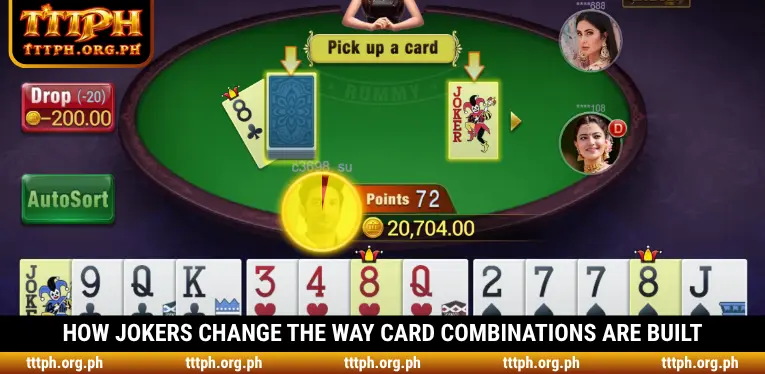
The important decision is knowing where a Joker offers the greatest value. If several natural cards are close to forming a Pure Sequence, players should preserve that combination and reserve Jokers for groups that are harder to complete. JILI also restricts players from picking up Jokers or Printed Jokers discarded by opponents, making it impractical to rely on retrieving them from the face-up pile.
How Penalty Points and Rummy Payouts Are Calculated
After a player makes a valid Declare, Rummy calculates penalty points based on the cards opponents have not arranged into recognized combinations. Card values directly influence the penalty total, so retaining high-value cards without useful combinations can increase potential losses. At TTTPH, players should distinguish penalty points from the actual wager and final payout.
| Category | Rule or value |
| A, K, Q, J | 10 points each |
| Cards 2 through 10 | Face value |
| Joker and Printed Joker | 0 points |
| With a Pure Sequence | Unmatched cards are scored according to the rules |
| With two required Sequences | Remaining invalid cards contribute to penalties |
| Maximum penalty score | 80 points |
| Missing a Declare opportunity | A 2-point rule is described in the game guidance |
| Both card piles exhausted | Player with the lowest score wins |
| Rake described in JILI guidance | 5% |
| Published Max Win | 320x |
Reading Opponents Through Their Draws and Discards
One of the most strategic aspects of Rummy is observing the face-up discard pile. When an opponent repeatedly picks up cards of the same suit or connected ranks, it may indicate that they are building a Sequence. For example, picking up 7♦ could suggest interest in nearby cards such as 6♦ or 8♦, although it never reveals the opponent’s entire hand with certainty.
Conversely, discarded cards may indicate combinations an opponent is no longer prioritizing. However, these observations are not definitive because players can change their plans or disguise their intentions. At TTTPH, the most useful approach is to consider visible draws and discards alongside the combinations needed in your own hand, rather than concentrating entirely on predicting opponents’ cards.
Strategies for Completing a Hand With Fewer Turns
Every draw and discard in Rummy can improve a hand’s structure or leave it exposed to higher penalty points. Players should prioritize decisions that move them toward a valid Declare instead of keeping several incomplete combinations without a clear purpose.
Build a Pure Sequence Before Expanding Into Other Sets
A Pure Sequence must be completed using appropriately ranked cards, making consecutive cards of the same suit particularly valuable early in the game. For example, holding 5♣ and 6♣ creates opportunities to complete a sequence with either 4♣ or 7♣. Once the Pure Sequence is secured, players gain more flexibility when organizing their remaining cards.

Use Jokers to Complete Difficult Card Combinations
A Joker can replace a missing rank in a Sequence or Set, but its usefulness depends on the current hand. For example, 9♥ and J♥ can form an Impure Sequence when a Joker represents 10♥. This reduces the need to draw one exact card and makes other available cards easier to organize during subsequent turns.
Discard High-Value Cards Without Clear Combination Potential
Aces, Kings, Queens, and Jacks each carry 10 penalty points if they are not part of recognized combinations. Players should therefore consider discarding isolated high-value cards, particularly when their Pure Sequence remains incomplete. The objective is not to remove every face card, but to reduce potential penalties if an opponent declares first.
Time Limits and Situations That Can Cause Invalid Declarations
Beyond forming combinations, Rummy requires players to complete their actions within the available time. The JILI version provides 20 seconds for drawing and another 20 seconds for discarding, so participants at TTTPH should prepare their next move before the turn begins.
- Drawing time expires: If no card is selected before the countdown ends, the system automatically draws a card from the face-down pile, removing the player’s choice.
- Discarding time expires: When a card has been drawn but no Discard action is completed, the system automatically discards the newly drawn card after the time limit.
- A completed hand reaches the time limit: According to the JILI guidance, the system may automatically process a Declare if all 13 cards have already been arranged into valid groups.
- Missing a Pure Sequence: Even if the entire hand appears organized, a Declare is invalid when the required Pure Sequence has not been formed.
- Missing the second Sequence: One Pure Sequence combined with multiple Sets does not meet the winning requirements because a second valid Sequence is still necessary.
Conclusion
Rummy rewards players who can recognize useful card combinations, adapt their decisions, and manage incomplete hands under time pressure. Building a valid Pure Sequence is only the beginning; knowing which cards to retain, replace, or discard can influence the outcome of every round. For players who enjoy multiplayer card games that emphasize observation and decision-making, TTTPH provides access to JILI’s Indian Rummy experience, where every draw presents a new strategic choice.
