

Texas Holdem is a popular poker variant where players combine two private cards with five community cards to form their strongest possible hand. At TTTPH, understanding the dealing rules, betting order, and different stages helps members approach each game more confidently. This guide explains hand rankings, Call, Raise, Fold, and essential poker strategies for making informed decisions while managing betting risks.
Overview of Texas Holdem at TTTPH
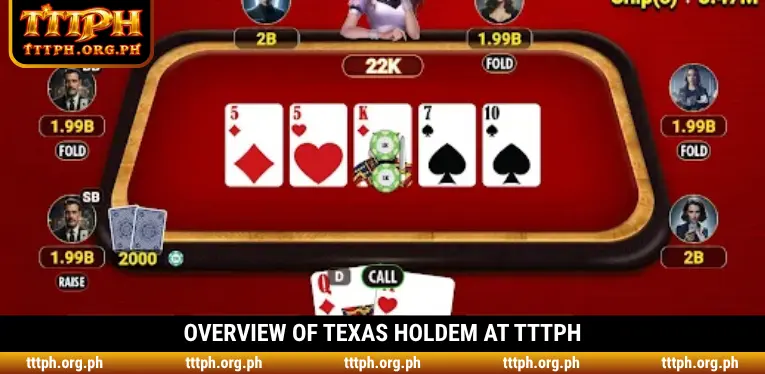
Texas Holdem is a competitive poker game played between participants at the same table, unlike Blackjack, which involves competing against the dealer. Each player receives two hole cards and uses the community cards to form the strongest five-card hand. A standard hand includes four betting rounds, allowing players to make decisions based on card strength, table position, and their opponents’ actions.
| Information | Details |
| Game title | Texas Holdem |
| Category | Poker |
| Deck | Standard 52-card deck |
| Private cards | Two hole cards per player |
| Community cards | Up to five cards |
| Betting rounds | Pre-Flop, Flop, Turn, River |
| Main actions | Check, Bet, Call, Raise, Fold |
| Objective | Win the pot with the strongest hand or force opponents to fold |
| Hand evaluation | Best five-card combination from seven available cards |
| Strategic factors | Position, probability, bankroll management, opponent ranges |
Card dealing rules and how winners are determined
In Texas Holdem, every participant receives two face-down hole cards, while five community cards are gradually revealed in the center of the table. Players can use both hole cards, only one, or neither to construct their strongest five-card hand. This flexibility is important because the final winning combination does not always require using the two originally dealt cards.
The winner is determined at Showdown if two or more players remain after the final betting round. Hands are compared according to standard poker rankings, with kickers used when necessary to distinguish otherwise similar combinations. However, players can also win the pot before Showdown if every remaining opponent folds. Consequently, the outcome depends on both card strength and betting decisions.
The four betting rounds that shape Texas Holdem
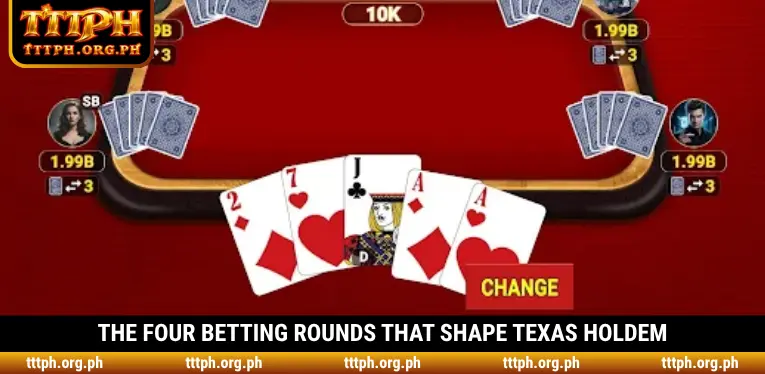
Understanding the four stages of Texas Holdem is essential for following how community cards are revealed and how money enters the pot. At TTTPH, knowing the sequence helps players recognize when to continue, increase their wagers, or fold to avoid unnecessary losses.
Pre-Flop begins with two private hole cards
Before the cards are dealt, the Small Blind and Big Blind post their mandatory bets according to the table rules. Each player then receives two private cards, and Pre-Flop betting begins. Starting hands such as high pocket pairs, A-K, and suited connectors can influence whether a player calls, raises, or folds based on position.
Flop reveals the first three community cards
After Pre-Flop betting concludes, three community cards are revealed simultaneously to form the Flop. Players may now have a pair, two pairs, three of a kind, or drawing possibilities for a straight or flush. Evaluating the board texture is important because coordinated cards can improve an opponent’s hand as well as the player’s own.
Turn adds the fourth community card
The Turn appears after Flop betting ends, adding a fourth shared card to the board. This card may significantly change the relative strength of a hand, especially when potential straights or flushes become more likely. Players should reconsider their chances of improvement, the amount required to call, and their opponent’s betting behavior before continuing.
River completes the board before Showdown
The River is the fifth and final community card. After the River betting round, players who have not folded reveal their hands at Showdown to determine the winner. Unlike earlier stages, no additional community cards will appear, so the decision to call, raise, or fold must rely on the completed board and previous betting actions.
Poker hand rankings from Royal Flush to High Card
One of the most important aspects of Texas Holdem is understanding how poker hands rank against one another. Players at TTTPH should recognize these combinations to evaluate Showdown results correctly, particularly when multiple opponents hold the same category of hand.
| Rank | Poker hand | Example |
| 1 | Royal Flush | A-K-Q-J-10 of the same suit |
| 2 | Straight Flush | 9-8-7-6-5 of the same suit |
| 3 | Four of a Kind | Four Kings |
| 4 | Full House | Three Queens and two Eights |
| 5 | Flush | Five cards of the same suit, not consecutive |
| 6 | Straight | Five consecutive cards of mixed suits |
| 7 | Three of a Kind | Three Tens |
| 8 | Two Pair | A pair of Aces and a pair of Sevens |
| 9 | One Pair | Two Jacks |
| 10 | High Card | No qualifying combination above |
Essential betting actions in Texas Holdem
Unlike games that only require selecting a winning outcome, Texas Holdem allows players to directly influence the size of the pot through their decisions. At TTTPH, understanding each betting action is fundamental to applying poker strategy and avoiding unplanned commitments.
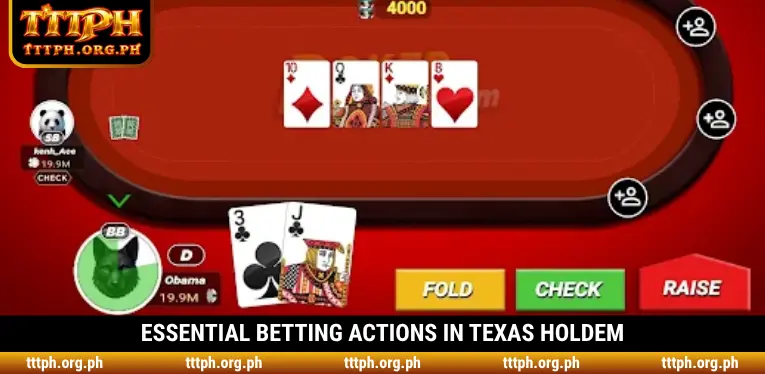
- Check: Pass the action without adding money when there is no outstanding bet to call. Checking keeps the player in the hand without increasing the pot.
- Bet: Place the first wager in a betting round when nobody has opened the betting. A bet can build the pot with a strong hand or pressure opponents into folding.
- Call: Match the amount required to remain in the hand. Before calling, players should compare the additional cost with their estimated winning chances and the current pot size.
- Raise: Increase the wager after another participant has bet, requiring opponents to match the new amount if they want to continue. Raises must follow the table’s minimum-increase rules.
- Fold: Give up the current hand and any claim to the pot. Folding is appropriate when the hand’s prospects or expected return no longer justify additional investment.
How to Play Texas Holdem at TTTPH
Before joining Texas Holdem, players should identify the available poker format, table limits, and blind structure. TTTPH provides access to the game, while specific buy-in requirements, betting limits, and controls should be checked directly at the selected table.
- Step 1 – Open the game: Log in to TTTPH, locate Texas Holdem in the relevant category, and enter an available poker table or room.
- Step 2 – Check the table conditions: Review the blinds, buy-in requirements, and betting limits to ensure the chosen table fits the available bankroll.
- Step 3 – Receive your hole cards: Examine the two private cards, identify your table position, and choose an appropriate Pre-Flop action based on starting-hand strength.
- Step 4 – Follow the community-card rounds: Reevaluate your hand during the Flop, Turn, and River while observing opponents’ bets, calls, and raises.
- Step 5 – Determine the result: At Showdown, compare the best five-card hands to determine the pot winner. If every opponent folds earlier, the last remaining player wins.
Why table position and blinds matter in poker
In Texas Holdem, table position determines the order of action and the amount of information available before making a decision. Players in Early Position act while several opponents have yet to reveal their intentions, making stronger starting hands particularly important. Late Position offers an informational advantage because players can observe earlier checks, bets, and raises before choosing their next move.
The Small Blind and Big Blind are distinctive positions because they contribute mandatory wagers before the cards are dealt. During the Flop, Turn, and River, players remaining in the blinds generally act before those in later positions. At TTTPH, recognizing the Dealer Button and blind positions helps explain why the same starting hand may require different strategies depending on where a player sits.
Texas Holdem strategies for more informed decisions
Effective Texas Holdem strategy involves more than waiting for premium cards. Players must also evaluate probability, position, and the potential financial consequences of each action. The following principles are especially relevant for beginners in the Philippines who want to approach poker systematically rather than making impulsive decisions.

Select starting hands according to position and strength
Premium pairs such as A-A, K-K, and Q-Q generally offer strong Pre-Flop potential, but not every hand should be played from every position. Suited connectors may develop into straights or flushes, although their value depends on stack depth, opposition, and betting pressure. Beginners benefit from selecting starting hands carefully instead of entering too many pots.
Calculate pot odds before deciding to call
Pot Odds compare the cost of calling with the total pot after the call is made. For example, if the pot is 100 units and calling requires another 25, the break-even equity is 25 divided by 125, or 20%. If the estimated chance of winning is lower and there are no additional profitable considerations, calling is generally unfavorable mathematically.
Evaluate opponents through possible hand ranges
Experienced poker players often assess an opponent’s Range, meaning the collection of hands that player might reasonably hold based on position and previous actions. A large raise from Early Position may represent a stronger range than a similar raise from Late Position. Evaluating several possible holdings is more reliable than assuming an opponent has one specific hand.
Common mistakes to avoid when playing Texas Holdem
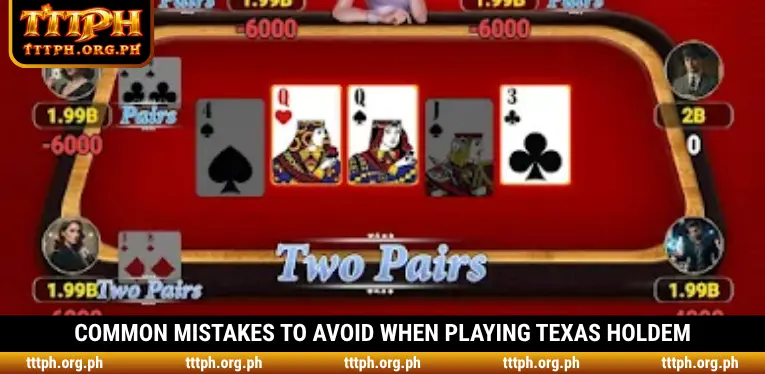
Although Texas Holdem can appear straightforward during the first few rounds, small mistakes in hand selection and betting discipline can accumulate into substantial losses. Players at TTTPH should distinguish sound strategy from attempts to recover previous losses, since each decision must be evaluated using the information currently available.
- Playing too many starting hands: Entering pots with weak cards from unfavorable positions frequently leads to difficult decisions and avoidable losses in later betting rounds.
- Calling because money is already invested: Previous contributions cannot be recovered simply by continuing with a negative-expectation hand. Decisions should depend on the present situation.
- Overvaluing a single pair: Top Pair can be strong on the Flop but becomes vulnerable when the board develops multiple cards of the same suit or connected ranks.
- Bluffing without considering opponents: Bluffing into several players or opponents unlikely to fold often increases risk without creating sufficient fold equity.
- Ignoring bankroll limits: Using essential living funds or repeatedly increasing stakes after losses can undermine financial control and the quality of poker decisions.
Conclusion
Texas Holdem combines hand reading, probability, and betting decisions across Pre-Flop, Flop, Turn, and River. Understanding poker hand rankings, table position, and actions such as Check, Call, Raise, and Fold helps players evaluate each situation more clearly. With proper bankroll management and a solid grasp of the rules, participants can approach the game with greater discipline. Visit TTTPH to find a suitable Texas Holdem table and put these fundamentals into practice.
